Mitsubishi Lancer Evolution X Pic For Mac
The 2008 Mitsubishi Lancer is a basic but sporty sedan with some tech features not often offered in this class. Every Mitsubishi dealer has a schizophrenic showroom. On one side of the room are the American-built Mitsus – the Galant sedan, Eclipse coupe, and Endeavor crossover. All three are based on the “Project America” platform and all three are relatively large machines. Meanwhile on the other side are the Japanese-made products – the Outlander compact crossover, the Montero large SUV, the amazing Lancer Evolution performance car and, our subject here, the all-new 2008 Lancer compact sedan. The Japanese products are a dimensionally diverse lot with more interesting engineering and direct appeal to enthusiasts. The dealers sell more from the American side of the dealership, but the good stuff is on the Japanese side.
I skipped over the Dodge-built Raider pickup, because no self-respecting Mitsu dealer would actually put one in his showroom. Plus it would interfere with the thesis of my convoluted introduction.
Mitsubishi is selling this newest Lancer as a “compact sport sedan” and so it must be taken on those terms. And on those terms, it’s pretty good. And it’s another indication that Mitsubishi is better off when it sends the best of what it builds in Japan over here rather than trying to tailor products for what it imagines America wants. All new, all familiar. SLK 2 shotVirtually nothing in the new Lancer carries over from the outgoing model, but virtually everything about this new car is familiar. The basic structure, for instance, is the same platform that underpins the Dodge Caliber, Jeep Compass, and Mitsu’s own Outlander small crossover. And there’s nothing revolutionary about this front- or all-wheel drive platform either; it’s a standard concoction of unitary steel body construction, transverse engine location, MacPherson strut front suspension, a multi-link rear suspension, and rack-and-pinion steering.
In short, it’s the same basic genetic soup out of which every reasonably priced sedan from Asia, Europe, Australia, and North and South America and Antarctica is born. Since it shares platforms with the Caliber it’s no surprise that many dimensions are similar.
The Lancer rides on the same 103.7-inch wheelbase as the Caliber, has a very slightly wider track, is slightly wider overall and, at 180.0 inches long is 6.3 inches longer than that Dodge. And all those dimensions are close to those of competitors like the Honda Civic, Toyota Corolla, and the Koreans. Dimensionally at least, there’s not much to distinguish the Lancer in the marketplace. The engine powering all versions – base DE, mainstream ES, and sportier GTS – of the new Lancer is an all-aluminum 2.0-liter DOHC four with 16 valves and Mitsubishi’s MIVEC variable valve timing scheme along to manage combustion. It’s a version of the same 2.0-liter that is available in the Caliber and it carries a rating of 152-horsepower (down six from the Dodge’s rating) when calibrated to Federal emissions standards and just 143 horsepower for the stricter California standards.
With its square 86-millimeter bore and stroke dimensions this isn’t an engine with much sporting character; it revs with some eagerness, but doesn’t have much to offer in the way of actual thrust once its 4250-rpm torque peak has been passed. The standard transmission in all models is a five-speed manual and a continuously variable automatic is optional. In the GTS that automatic also carries a “Sportronic” shifting scheme with six simulated forward gears.
The DE comes wearing steel 16-inch wheels, P205/60R16 and drum rear brakes with ABS optional. Step up to the ES and the wheels are the same diameter but done in alloy, the tires are the same and ABS is standard. Finally going for the GTS means the four ABS-equipped disc brakes are bumped up in size a bit along with the wheels that grow to 18-inches in diameter and the tires slightly wider P215/45R18s. Both the ES and GTS have front and rear stabilizer bars (the GTS’ are slightly thicker), while the DE makes do with just a front one. The basic mechanical packages of cars in this class are all so similar that I could just mark the Lancer as engineered to the Universal Japanese Sedan (UJS) standard and leave it at that. Good looking, good feeling.
FirstDrive/Mitsubishi Evo X:There are just two examples of the Lancer Evolution X in Europe right now and Shane O' Donoghuewas lucky enough to take one to the Wicklow Mountains December: the very mention of the month conjures up images of hurried, last-minute Christmas shopping and a rush to celebrate the end of one year and the start of the next. For motorists, it's a particularly challenging time. Schemes such as Operation Freeflow attempt to ease the pain caused by the mass consumerism, but nothing can be done about the weather. If the cold doesn't prevent your car from starting, then it'll try to trip you up on your way to work as already damp roads are transformed into treacherous ice rinks. December is not the time of year in which to test a supercar. But the Mitsubishi Lancer Evolution X is no ordinary supercar.
Although the Evolution series is often associated with boy racers in this country, the truth of the matter is that it offers ballistic supercar-baiting performance for about the price of a mid-range compact executive saloon. Not only that; while owners of cherished Porsches and Ferraris wrap their pride and joy up in a warm cotton wool cocoon for the winter, Mitsubishi Evo owners come out to play and revel in the car's all-weather ability. The 10th edition in the series goes on sale in Ireland next year and the hype surrounding the car has been tremendous, including a long drawn out revealing of the showroom-ready model throughout the past 12 months. Japanese-spec models have been driven in its home market, but as yet the European specification is not completely finalised. However, Motors has been lucky enough to get its hands on one of only two pre-production cars available in Europe for a brief drive. On the way down the choked M50 to the deserted, open roads around Sally Gap in Wicklow, the new car draws less interest than expected.
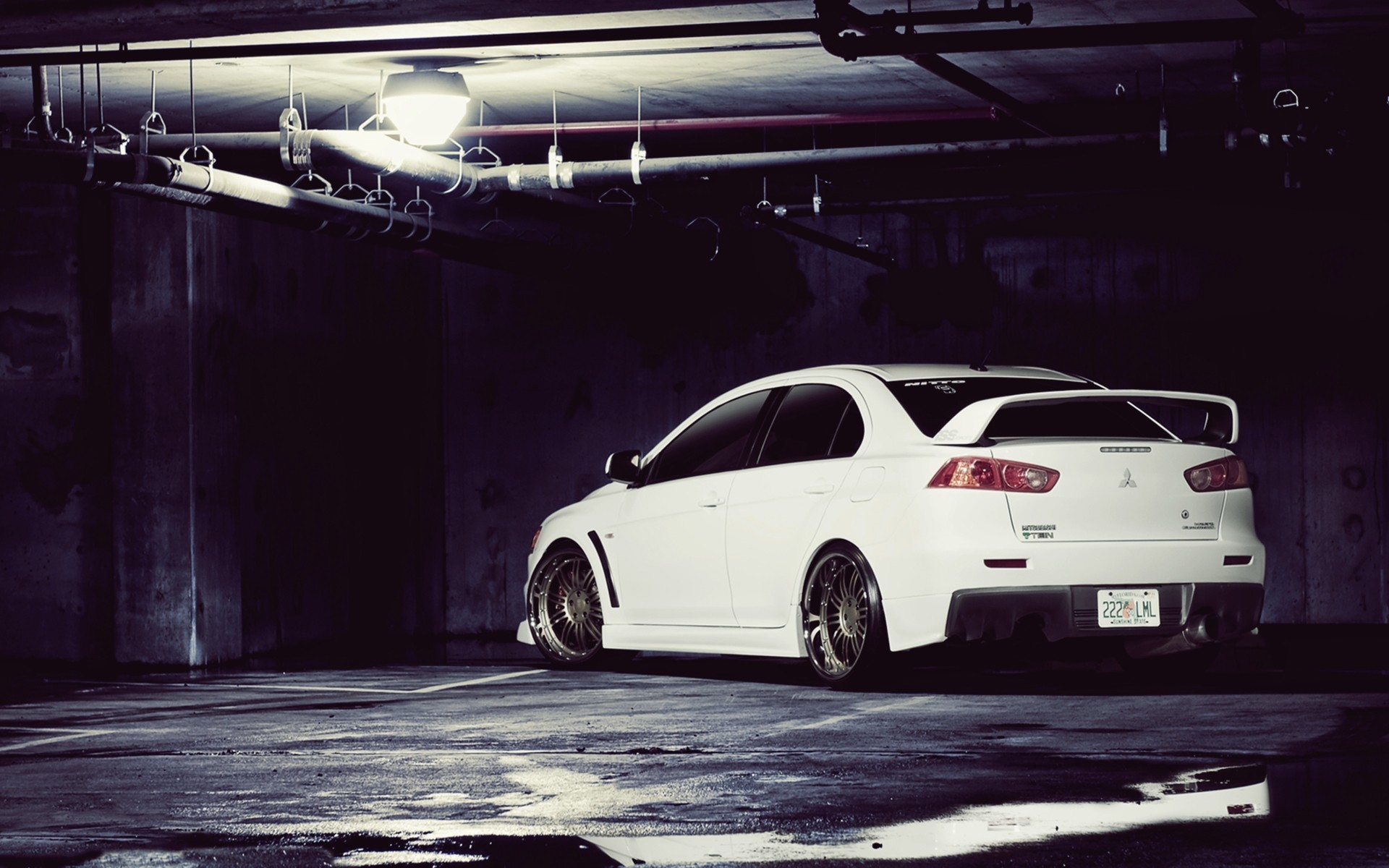
It may be thought of as odd to describe a car with a huge boot spoiler as subtle, but the new Evo is a far less aggressive design than some of its predecessors. The new Lancer saloon is a great looking car, so the Evolution doesn't need to be significantly different. However, taking a closer look reveals that more panels have been replaced than first suspected.
Along with the more bulbous wings, a vented bonnet, new bumpers and wheels we noticed that the roof has been reprofiled too, featuring two longitudinal edges not found on the regular Lancer. We can only assume that these are intended to channel air to the rear spoiler. One of the major criticisms of the last couple of iterations of the Evo was of the low rent interior. Better things are expected of the Evo X though, especially as the new Lancer features a thoroughly modern cockpit. The Evo's interior is remarkably restrained, featuring excellent Recaro bucket seats, a new sports steering wheel and a few different buttons to the regular car. Starting it up is a normal key turning process too and at idle there's nothing to betray the motorsport aspirations of Mitsubishi's new 2.0-litre turbocharged engine.
Indeed, where the old car juddered and made itself known by a blaring exhaust (even at town speeds), the new car potters along as smoothly as any normal car. We did have a few issues with gear selection in the five-speed manual box, but it's unlikely that such things will make it through to the final production car. Gear shift aside, even at sedate speeds it's obvious that Mitsubishi has got the driving controls right. The steering is not particularly heavy, but it's weighty enough to let you know what the front wheels are doing and is deliciously direct.
Mitsubishi Lancer Evolution Specs
Likewise, the brakes are perfectly modulated, allowing precise and smooth speed retardation. Finally the road opens up and the traffic disappears. Despite the wintry conditions, the Evo is in its element and it takes just a single surge of acceleration through the ratios to dispel the feeling that the new Evo could be a bit ordinary. Straight line speed is, unsurprisingly, impressive, but more so is the engine's flexibility. Although there's a noticeable increase in thrust as the turbocharger gets up to speed, the engine's new variable valve timing ensures that meaningful acceleration is still available at lower engine speeds. The only criticism of the power plant at this stage is the lack of any charisma in the noise it makes. The Evo's party trick has always been its chassis and first impressions suggest that Mitsubishi will continue that trend with the X.
Mitsubishi Lancer Evolution X Price
Needless to say, there is precious little body roll while cornering, nor dive while braking, but perhaps more impressive than all of that is the new found comfort. Where previous generations of the Evo tended to crash over our typically rutted roads, the new car absorbs the bumps and cossets its occupants - relatively speaking. Time was short, with the test car due to be in the UK a few hours after the drive, so there was no chance to experiment with the various chassis settings available, but this first tentative test suggests that the Evolution X could be the most complete car of the series so far.
Lancer Evolution X Wheels
Roll on February, when we drive the finished product. February is a good month for testing supercars. Factfile ENGINE:1,997cc turbocharged four-cylinder petrol engine with intercooler, putting out approximately 300bhp and 422Nm of torque @ 3,500rpm TRANSMISSION:Choice of five-speed manual or six-speed Twin Clutch Sport Shift Transmission (SST). Super All Wheel Control, Active Stability Control, Active Centre Differential, Active Yaw Control, Sport ABS.