Cry The Beloved Country Generator For Mac
- Cry The Beloved Country Generator For Mac Free
- Cry The Beloved Country Dvd
- Cry The Beloved Country Online
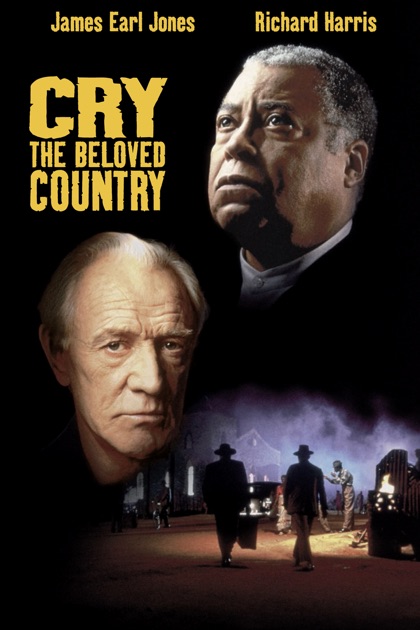
While we can't necessarily speak for the 'Beloved Country' (South Africa) of Alan Paton's heartwrenching 1948 novel about racism and injustice, we can say that Cry, the Beloved Countrymade us weep buckets of tears. We can promise that, if Paton had called the book Cry, the Beloved Shmoop, the title would definitely have been accurate.
And we aren't alone in finding Paton's work incredibly moving and powerful. Not only is his novel an Oprah's Book Club pick, but in the forty years between its publication in 1948 and Paton's death in 1988, it was translated into at least twenty languages and sold over fifteen million copies worldwide.
What's more, as South Africa's first internationally bestselling author, Paton paved the way for later well-known South African writers such as Nobel Prize winners. Without a doubt, Paton's legacy as a writer and as a social reformer continues on today.
As for how Paton came to write his hugely successful book, we have to start with his pre- Cry job. Paton is definitely in the running for Shmoop's Most Unusual Day Job For an Author prize: before quitting to become a novelist full time after the financial success of Cry, the Beloved Country, Paton was a warden at Diepkloof, a juvenile detention center for black youth ages nine to twenty-one, in the segregated city of Johannesburg. As Paton started running Diepkloof, he realized exactly how bad the public facilities available for black people could be in South Africa. When he first arrived at the reform school, he saw that the youths were locked into their rooms at night (with around twenty per room) with a container of water to share and an empty bucket to pee in until the next morning. So while Paton worked to improve these awful conditions for the young men living at Diepkloof, he also used some of his experiences there as a source for his novel, to spread the word about social causes for the growing racial inequality dividing the nation. Even though Cry, the Beloved Country actually appeared before racial segregation in South Africa reached its absolute worst stages in the 1950s through the 1980s, Paton's passionate and heartfelt discussion of prejudice has made his novel consistently relevant throughout South Africa's later anti-racist political struggles. It's one for the ages.
Looking at the diversity of South African life now, it is amazing to think that just twenty years ago, the country was still struggling through one of the bitterest racial struggles of modern history. As a black man, was only legally allowed to vote in his home country for the first time in 1994, when he was elected president. Talk about an incredible turnaround.
Paton's Cry, the Beloved Country obviously takes place long before Mandela's historic election and the start of a new, more racially equal South Africa. In 1948, the same year that Paton first published Cry, the Beloved Country, the Afrikaner National Party came up with the term apartheid to describe its new, stricter set of policies intended to enforce white legal domination over the black people of South Africa. 'Apartheid' means 'apartness' in Afrikaans, the language spoken today by the Afrikaners, descendants of 17th- and 18th-century Dutch settlers in southern Africa. Because Paton's novel appeared around the same time that South Africa's racist laws began to grow really strict and far-reaching, Cry, the Beloved Country has always been associated with the policies of apartheid. Like the in the American South, apartheid limited the ways that black people and white people could interact.
But apartheid went further than American segregation because under apartheid, all black people in South Africa (who make up a huge majority of the population) had to register their addresses with the cops. They also had to live in specially selected areas out in the countryside or around the edges of major cities. These settlements (a.k.a. Townships) were much, much poorer than the white districts of the country.
Many of the white people who believed in apartheid felt that it was actually the divine purpose of the Afrikaner people to maintain the racial superiority of whites over black people in South Africa. Many more white business owners also took advantage of these racist policies to improve their profits by forcing their black workers to work for very little pay. Both of these motivations—white supremacist racism and the greedy desire for economic advantage—appear in Cry, the Beloved Country to explain why so many white South Africans resist even basic social reform. So even though Paton's book appeared right at the beginning of apartheid, Cry, the Beloved Country warned of some of the horrible damage that legalized racism would do to South African society—at least, that is, to people who were willing to listen. We have to give Alan Paton a lot of credit for his work fighting racist attitudes towards black crime and poverty under South Africa's unfair economic and political structures.
Cry The Beloved Country Generator For Mac Free
But we can't deny that despite his good intentions, there are parts of this book are pretty hard to take nowadays. What may have looked liberal sixty-odd years ago can seem a bit high-handed and patronizing by today's standards. For example, many of Paton's white characters are kindly but frankly condescending helpers for the often-confused and overwhelmed black main character, Kumalo. And Kumalo is grateful to receive help, without many larger ideas or reform plans of his own. We get into some of Paton's biases against black activism in our 'Character Analysis' of. And be sure to check out our analysis of for more on the paternalism' (in other words, well-meaning but sometimes excessive meddling) of these white characters.
Cry The Beloved Country Dvd
What is Cry, the Beloved Country About and Why Should I Care?
Cry, The Beloved Country Alan Paton 'But there is only one thing that has power completely, and that is love. Because when a man loves, he seeks no power, and therefore he has power. I see only one hope for our country, and that is when white men and black men.come together to work for it' (71). Msimangu is defining the power of love uniting even people of different races, during this indifferent time, together. It also shows that even early on in the novel, Msimangu has indefinite wisdom and love for his country. Cry, The Beloved Country 'But there were times in the very midst of satisfaction when the thought of his son would come to him.and then in one fraction of time the hills with the deep melodious names stood out waste.the streams ceased to run.' The power of love that is shown in this quote, especially between father and son, overcomes all the love for anything else.
Cry The Beloved Country Online
Cry, The Beloved Country 'This is no time to talk of hedges and fields, or the beauties of an country. Sadness and fear and hate, how they well up in the heart and mind, whenever one opens the pages of these messengers of doom' (104). In contrast to the beginning of the novel where lush scenery is described and the love is inscribed within the words, the love changes in this section, and it describes the problems that are going on within this time. Cry, The Beloved Country 'One can read, as I read when I was a boy, the brochures about lovely South Africa, that land of sun and beauty sheltered from the storms of the world, and feel pride in it and love for it, and yet know nothing about it at all' (207). Readers can tell that even from Kumalo's point of view, Paton's words are breaking through containing his strong love for South Africa, which again supports the theme that love for your country can stimulate hope among others and yourself. Cry, The Beloved Country 'What broke in a man when he could bring himself to kill another?
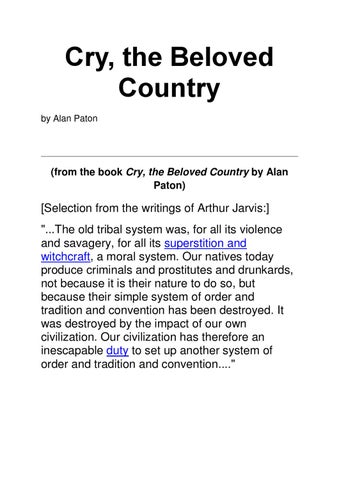
What broke when he could bring himself to thrust down the knife into the warm flesh, to bring down the axe on the living head, to cleave down between the seeing eyes, to shoot the gun that would drive death into the beating heart?' Paton's strong words are supporting that human beings are extradorinary, filled with so many emotions such as love, and to kill another, is a broken task to do. Cry, The Beloved Country Cry, The Beloved Country 'He had come to tell his brother that power corrupts, that a man who fights for justice must himself be cleansed and purified, that love is greater than force. And none of these things had he done He turned to the door, but it was locked and bolted. Brother had shut out brother, from the same womb had they come' (246). Although a conflict with the theme, love being hope is stressed during this situation and readers get a sense of who is a more courageous, loving person that gives others and himself hope, Stephen Kumalo. Cry, The Beloved Country 'Pain and suffering, they are a secret.
Kindness and love, they are a secret. But I have learned that kindness and love can pay for pain and suffering' (261). This is describing that love can achieve all things, even a big emotion such as pain and sadness. It also shows how love is a unifying power that can bring people together. Cry, The Beloved Country 'For it is the dawn that has come, as it has come for a thousand centuries, never failing. But thwhen that dawn will come, or our emancipation, from the fear of bondage and the bondage of fear, why, that is a secret' (312).
Talking about the equality of man, but also the love for mankind and the country around him, Paton ends the novel with a paragraph detailed with lush sceneries, much like the first paragraph of the book. This is emphasizing his love for beauty and nature which in turn bring hope into the community.
Cry, The Beloved Country Paton wants readers to take away the fact that love conquers everything. Being healthy, happy, successful, not corrupt, and bringing the community together can all come from love.
Love gives hope to all, even within people or within the community, and that is what Paton wanted readers to take away from Cry, The Beloved Country. Transcend storejet 2tb sjm300 for macbook pro. Cry, The Beloved Country Love is hope of redemption, both for a personal effect and an effect on an entire country. 'And he told them all about these places, of the great hills and valleys of that far country. And the love of them must have been in his voice, for they were all silent and listened to him' (52). Written by Paton, this quote offers insightful evidence that Stephen Kumalo has a strong love for his country, and even talking to different colored people, can bring everyone together because of the love of the country. Alexis Wisdom.